Need help clearing up your pool after the next storm? Call today to schedule pool cleaning service in Tracy, CA and get your water back to crystal clear.
Home / Single Post
If your pool looked crystal clear yesterday and now it is cloudy, dull, or starting to turn green after a storm, you are not alone. In Tracy, CA, even a short burst of rain can knock your pool water out of balance fast. Add a little wind, dust, and yard debris, and your filtration system suddenly has a lot more work to do.
This guide breaks down exactly why rain causes issues, what to do right after it rains, and how to get your water back to clear without wasting time or chemicals. If you are searching for pool cleaning after rain tips that actually work, start here.
Rainwater is not “neutral.” It changes what is happening in your pool in a few different ways, and the combination is what causes that overnight water shift.
1) Rain dilutes sanitizer and throws off balance
When rain adds water to your pool, it can dilute chlorine and disrupt key levels like pH and total alkalinity. Even if the water looks fine at first glance, a lower sanitizer level can open the door to algae and cloudy water within 24 to 48 hours.
2) Storm debris increases your chlorine demand
Rain usually comes with wind. In Tracy, that often means dust, fine particles, leaves, and other debris get pushed into the pool. All of that organic material consumes chlorine. So you can have “enough” chlorine on paper, but it gets used up quickly fighting contaminants.
3) Runoff can bring in extra organics and nutrients
If your pool deck drains toward the water or if landscaping washes into the pool, runoff can carry soil and organic matter. That increases the load on your filter and can feed algae. The water may go cloudy because there are simply more tiny particles floating around than your system can catch quickly.
4) Your filter has to do more work, faster
After a storm, your filter is catching debris and fine particles continuously. If it is already due for cleaning, it can clog fast and reduce circulation. Reduced circulation makes everything harder: chemicals do not distribute evenly, skimming weakens, and debris stays suspended.
Here are the most common issues homeowners notice after rain, and the most likely causes:
Cloudy pool after rain: usually a combination of low sanitizer, fine debris, and a filter that needs help
Green tint or algae spots: sanitizer dipped too low, circulation was not strong enough, or algae already had a foothold
Strong chlorine smell: often means chloramines are building up, not that your water is “extra clean”
Filter pressure rising: your filter is loading up quickly and restricting flow
Debris collecting in corners: circulation patterns are weak or the pool needs brushing to push debris into the system
If you do these steps early, you can prevent the “storm hangover” where the water gets worse over the next few days.
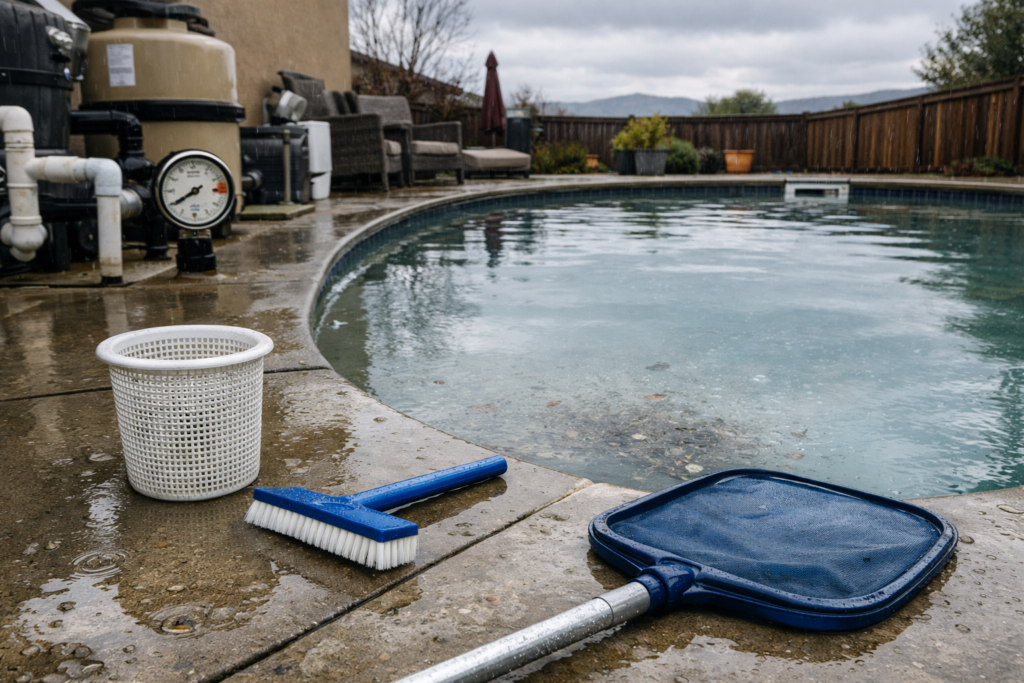
Step 1: Skim the surface and empty baskets
Remove leaves, twigs, and any floating debris. Then empty:
Skimmer basket(s)
Pump basket
This helps restore flow and improves skimming immediately.
Step 2: Brush walls, steps, and corners
Brushing knocks dirt and algae spores loose so your filter can catch them. Focus on:
Steps and benches
Corners and tight areas
Tile line and waterline
Step 3: Vacuum if you see debris on the floor
If the pool floor looks dusty or gritty, vacuum it. Leaving debris sitting on the bottom often leads to staining and algae.
Step 4: Run the pump longer for 24 to 48 hours
After storms, longer run time helps the filter catch fine particles and improves chemical distribution. If you normally run your pump 6 to 8 hours, you may need 10 to 12 hours temporarily depending on conditions and water clarity.
Step 5: Test your water before adding chemicals
At minimum, test:
Free chlorine
pH
Also helpful:
Total alkalinity
Stabilizer (CYA)
If your water is already drifting, adding random products can make it harder to stabilize.
Step 6: Check your filter pressure and flow
If your pressure gauge is notably higher than your clean baseline, it is time to clean or backwash the filter. More on that below.
The goal is simple: restore sanitizer, rebalance pH, and keep circulation strong enough to clear the water.
Step 1: Test first, then adjust in the right order
A reliable order for most pools is:
Free chlorine
pH
Total alkalinity
Stabilizer (CYA)
Why this order matters: chlorine effectiveness depends heavily on pH and stabilizer. If pH is too high or stabilizer is out of range, you may feel like you are “adding chlorine” but not seeing results.
Step 2: Raise chlorine if it is low
If your free chlorine is below your normal target, bring it up promptly. After rain, chlorine often dips because it was diluted and used up fighting contaminants.
Tip: If your water is cloudy or you suspect algae is starting, raising chlorine is usually more effective than adding clarifiers right away.
Step 3: Adjust pH to keep chlorine working efficiently
Rain and organics can shift pH. When pH is off, chlorine is less effective and water can look dull. Bring pH back into a normal range for your pool.
Step 4: Decide if shock makes sense
You do not need to shock after every storm, but it can be the right call when:
Water is cloudy and chlorine is low
There is a strong odor and water feels “stale”
You see early algae spots on steps or walls
The pool took on heavy debris or runoff
Always follow product directions and handle chemicals safely.
Step 5: Clarifier vs floc, which should you use?
If your pool is cloudy after rain, you might be tempted to grab a bottle of something. Here is a simple way to decide:
Clarifier: helps your filter capture fine suspended particles over time. Works best when filtration and circulation are strong.
Floc: forces particles to drop to the floor quickly, but requires vacuuming to waste. If you do not have the right setup or you vacuum incorrectly, you can make the problem worse.
In many cases, the best “clarifier” is proper chemistry plus extended filtration and a clean filter.

A big portion of post-storm recovery is mechanical, not chemical.
Watch your pressure gauge
Your filter pressure gauge tells you when the filter is loaded. The key is knowing your clean baseline. If pressure rises meaningfully above that baseline, flow drops and your water will struggle to clear.
Filter-specific guidance
Cartridge filters
Rinse thoroughly after storms when pressure is up
If the cartridge is oily or heavily soiled, a deeper clean may be needed
Make sure the pleats are not collapsing or damaged
Sand filters
Backwash when pressure rises above normal
After backwashing, rinse as recommended for your valve system
If sand is old or channeling, clearing cloudy water becomes harder
DE filters
Backwash and recharge DE as needed
Torn grids or poor DE recharge can cause cloudy water to return quickly
Improve circulation and surface movement
After rain, you want visible surface movement so the skimmer can do its job. If you notice dead zones:
Aim return jets slightly downward and toward a circular pattern
Brush debris toward the main drain or toward returns
Check for clogged baskets or air leaks that reduce flow
Algae does not wait for summer. Mild temps and storm debris can trigger growth even outside peak heat. Here is what helps most:
Keep sanitizer consistent: do not let chlorine sit low for multiple days
Brush at least weekly: more often after storms or windy days
Clean the filter on schedule: post-storm is when overdue filters get exposed
Maintain pump run time: shorter run time plus dirty filter equals weak circulation
Address problem areas: steps, corners, and shallow ledges are prime algae spots
If algae is becoming a recurring issue, a weekly pool service plan often costs less than repeatedly buying chemicals and fighting the same cycle.
Use this as a practical plan for pool cleaning after rain in Tracy, CA:
Same day
Skim surface and empty baskets
Brush walls, steps, corners
Run pump longer
Test chlorine and pH
Next day (24 hours later)
Re-test water and fine-tune chlorine and pH
Vacuum if debris is still present
Check filter pressure and clean/backwash if needed
Continue extended filtration if water is cloudy
Within 3 to 5 days
Confirm water is holding sanitizer
Check clarity and address fine haze with filter cleaning and circulation
If issues persist, inspect for equipment problems or consider a professional cleanup
DIY is great when the pool responds quickly. But sometimes the fastest and most cost-effective move is calling a pro, especially when:
Water stays cloudy after 48 hours of filtration and balancing
Algae returns repeatedly or spreads quickly
Filter pressure remains high even after cleaning
Pump is noisy, losing prime, or pushing weak flow
You suspect a leak, suction issue, or equipment malfunction
You want the pool ready for guests or an upcoming warm weekend
A professional pool cleaning service in Tracy, CA can typically restore clarity faster by combining correct chemical dosing, filtration optimization, and hands-on debris removal.
Wrigley’s Pool Co is a trusted provider of residential and commercial pool services and repairs in Tracy, CA and surrounding communities.
Have questions or need assistance? Our team is here to help – don’t hesitate to reach out.